Update: The Ivy Park Rodeo collection is now available to shop on adidas.com and below.
This story was originally published on August 6, 2021.
Giddy up: For her latest Ivy Park collection with Adidas, Beyoncé released a Rodeo-themed campaign video that, like any good Western, will have you on the edge of your seat saddle.
In the nearly two-minute promo, which the brand posted on Instagram on Friday, viewers will find model Paloma Elsesser, musician Orville Peck, singer Snoh Aalegra, and, of course, Queen Bey herself. Musician Monaleo and Emmy-winning actor Glynn Turman also star in the campaign.
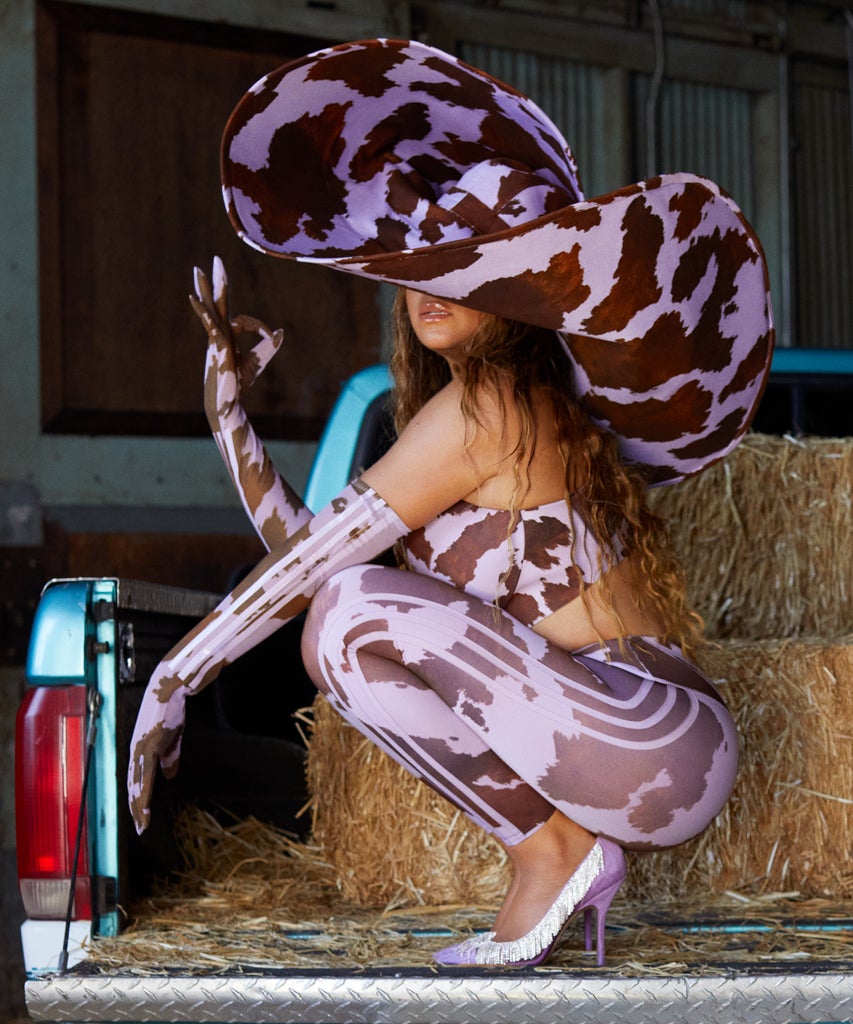
But even with the star-studded cast, the collection remains the star. Included in the video are denim corsets and matching chaps, Canadian tuxedos worn with Ivy Park-embossed belt buckles, crystal-covered cowboy hats, and fringe face masks that take bandanas to a whole new level. Those, and a pink-and-brown cow-print workout set with opera-style gloves to match. (Casual.)
To showcase that, Ivy Park posted an Instagram video earlier this week that showed Turman and his granddaughter Melinda, wearing pieces from the collection while caring for horses on a ranch. “I’ve always loved horses, ever since I was a kid,” Turman says in the video. “I used to go up to Central Park to the stables and I’d say to the man, ‘Hey, I’ll shovel all that horse manure if you’ll let me ride the horse for free.’” Turman — in addition to starring in shows like Fargo, The Wire, and How To Get Away With Murder — co-founded a free Western-style summer camp for inner-city and at-risk youth with his wife Jo-Ann, according to the Instagram post’s caption. He also won the 1999 Regional Team Roping Finals, was inducted into the Western Heritage Multi-Cultural Museum’s Hall of Fame in 2011, and was instrumental in bringing the Black Rodeo to CBS on Juneteenth this year.
The #IVYPARKRODEO collection is the second Ivy Park drop that Beyoncé has orchestrated this summer. A swim collection, called #IVYPARKFLEX, launched on July 22. Similarly, the line — which included orange floss bikinis, mesh naked dresses, and baby tees — came with its own talent, including Chloe Bailey, model Tabria Majors, and Jay Z.
At Refinery29, we’re here to help you navigate this overwhelming world of stuff. All of our market picks are independently selected and curated by the editorial team. If you buy something we link to on our site, Refinery29 may earn commission.
Like what you see? How about some more R29 goodness, right here?
// Show numbers on the images in page, set to false before publish to turn them off const toolsOn = false; // Should dots be onclick for all views? const clickOn = false; // ////////////////////// ANNOTATIONS CODE ////////////////////// // // Setup Annotation Content, the first spot is 0, second spot is 1 etc. let content = new Array ( "
"I love this sweater not only because it keeps me warm, but because I know it will match any outfit I throw on."
"These sweat shorts are so soft and comfortable. They're perfect for lounging around in while still looking cute — even if it’s only for me to see."
"I like to be comfortable but look put-together when I work from home, and there’s something magical about matching sets that do that for me."
", "
"I don’t know what it is about cardigans, but I think they have superpowers. Not only is this one practical and chic, but I love the way it frames my whole outfit."
"Gimme a little pattern play any day! This breezy tank adds the perfect whimsical touch."
"I’m all about comfy-cute these days, and these shorts are the true embodiment of that. I love how seamless, effortless, and cozy they are."
"It doesn’t get better than a goes-with-everything purse that’s as functional as it is pretty."
"As a sneaker girl, I forgot how much I love sandals — these are cool-looking and also easy to walk in."
", "
"I love the rugby shirt because it's loose and it's olive green (my favorite silhouette and color)."
"Plaid skirts are my closet must-have — they're easy to style and so versatile. I can wear them anywhere, from skating to running errands."
", "
"I love a good knit cardigan — this one is cozy and lightweight, both which I'm a huge fan of."
"I'm all about comfort, and this top has the softest, most breathable fabric."
"I would wear these shorts all day every day if I could (plus, they don't ride up when you walk)."
")}} function countDots() { let annos = document.querySelectorAll(".anno-dot"); let count = annos.length; let n = document.createElement("DIV"); n.setAttribute("class", "dotCount"); if (toolsOn == false) { n.style.display = "none"; } let w = document.getElementsByClassName("body"); w[0].appendChild(n); n.innerHTML = "
Setup CSS for " + count + " dots & pops
"; } // Setup Annotations, do not alter var grabnav, elem = new Array(), mobilebuy = new Array(), closebutton = new Array(), init = !1, previous = 100, mobile = !1, desktop = !0; function assembleArray(n, e) { return [document.getElementById("anno-tip" + n), document.getElementById("anno-dot" + n + "-hint"), e]; } function tipOn(n) { var e = n[0], i = n[1], t = n[2]; 0 == init && (initAnnotations(), (init = !0)), 1 == mobile ? (showPop(e, t, !0), window.innerWidth < 768 && hideGlobalNav()) : window.innerWidth < 768 ? (showPop(e, t, !0), hideGlobalNav()) : (showPop(e, t, !1), showHint(i)); } function tipOff(n) { var e = n[0], i = n[1], t = n[2]; 1 == mobile ? (hidePop(e, t, !0), window.innerWidth < 768 && showGlobalNav()) : window.innerWidth 540 && mobileExtraOn(n); } function closeTip(n) { tipOff(assembleArray(n, "0")), window.innerWidth > 540 && mobileExtraOff(n); } function showTip(n) { 1 == desktop && window.innerWidth > 720 && tipOn(assembleArray(n, "-15%")); } function hideTip(n) { 1 == desktop && window.innerWidth > 720 && tipOff(assembleArray(n, "0")); } function mobileExtraOn(n) { (mobilebuy[n].style.display = "block"), (closebutton[n].style.display = "block"); } function mobileExtraOff(n) { (mobilebuy[n].style.display = "none"), (closebutton[n].style.display = "none"); } function initAnnotations() { document.getElementsByClassName("global-header")[0].setAttribute("id", "tmp-global-header"), (grabnav = document.getElementById("tmp-global-header")), (mobilebuy = document.getElementsByClassName("anno-mobile-buy")), (closebutton = document.getElementsByClassName("anno-tip-close")); } function showGlobalNav() { grabnav.style.display = "block"; } function hideGlobalNav() { grabnav.style.display = "none"; } navigator.userAgent.match(/Android|BlackBerry|iPhone|iPad|iPod|Opera Mini|IEMobile/i) && ((mobile = !0), (desktop = !1)); function setupAnnotation(t, e) { let n = document.querySelectorAll(".section-image .img-container"), o = document.createElement("DIV"), l = ["an" + e]; n[t].classList.add("anno-layers"), n[t].setAttribute("id", l), n[t].appendChild(o), (o.innerHTML = content[e]), (content[e] = void 0), 0 == e; } function setAnnoDelays(t) { let e = ["#an" + t + " .anno-dot"], n = document.querySelectorAll(e); for (let e = 0; e < n.length; e++) { let n = ["#an" + t + " .anno-dot"], o = ["anno-dot-delay" + e]; document.querySelectorAll(n)[e].classList.add(o); } } function setClick(t, e) { let n = ["openTip(" + e + ")"]; t.setAttribute("onclick", n); } function setRollover(t, e) { let n = ["showTip(" + e + ")"], o = ["hideTip(" + e + ")"]; t.setAttribute("onmouseenter", n), t.setAttribute("onmouseleave", o); } function activateAnnotations() { let t = document.querySelectorAll(".anno-dot"); for (let e = 0; e 760 && 0 == clickOn ? setRollover(t[e], e) : setClick(t[e], e); } } function setupPopups() { let t = document.querySelectorAll(".anno-tip"); let tc = document.querySelectorAll(".anno-tip-close"); let ti = document.querySelectorAll(".anno-tip-image"); for (let e = 0; e < t.length; e++) { let tid = ["anno-tip" + e]; t[e].setAttribute("id", tid); let tcid = ["closeTip(" + e + ")"]; tc[e].setAttribute("onclick", tcid); let tiid = ["anno-tip" + e + "_img"]; ti[e].setAttribute("id", tiid); if (clickOn == true) { tc[e].style.display = "block"; } } activateAnnotations(); } function setup() { // Annotations, set number based on image tag using the tag images function // first variable is image location // second variable is the content array position setupAnnotation(0,0); setupAnnotation(1,1); setupAnnotation(3,2); setupAnnotation(4,3); // Setup the popups setupPopups(); setAnnoDelays(0); setAnnoDelays(1); setAnnoDelays(2); setAnnoDelays(3); // Number the images, turn off for publish tagImages(); // How many dots to css countDots(); } /* Preload */ function ready(e){(document.attachEvent?"complete"===document.readyState:"loading"!==document.readyState)?e():document.addEventListener("DOMContentLoaded",e)}document.onmouseleave=function(){window.isReady=!1},window.addEventListener("resize",function(){window.isReady=!1}),window.isReady=void 0!==window.isReady&&window.isReady,ready(function(){var e=setInterval(function(){window.imagesLoaded&&(imagesLoaded("#tmp-load",{background:!0},function(){window.isReady=!1,clearInterval(e)}),clearInterval(e))},100);if(!1!==window.isReady)return;window.isReady=!0;const t=setTimeout(function(){clearTimeout(t),setup()},300)});
It’d be narrow-minded to believe that buildings exist to provide nothing more than shelter, constructed with brick and mortar and little else, or that parks are simply areas in which to congregate. The truth is, these spaces are layered with meaning and etched with stories by the people who occupy them. In partnership with Aerie, we asked four New Yorkers — some born and bred; others transplants — to pinpoint the places that hold meaning to them. For one, it’s a memory of one specific street that has shaped her into the person she is today; for another, it’s an ice cream shop that serves as an embodiment of her body acceptance journey. Scroll through to read their inspiring stories, told in their own words.
Christianne Gromley
Freelance Vice Media Group Video Editor & Producer, 25 Location: Brooklyn Bridge Park, Dumbo
Three years ago, right after college, I moved to New York City with nothing but two suitcases. No job, no friends, no apartment. But it didn’t matter; I knew the city was going to be my home. I'd known since high school — as the lone artist in a sea of jocks, as one of only a handful of Filipinos living in the tiny, predominantly white town of Hot Springs, Ark. (my graduating class was a total of seven people) — that New York City was where I was meant to be. I felt like it was the place where I could be whoever I was, without feeling like I was the weird one.
Things worked out: I found an apartment in downtown Brooklyn through the Roomi app, and I met friends through church, supplemented by visits from my college friends who lived on Long Island. But, I’ll admit, it was lonely at first. I spent a lot of time in my room writing, applying for jobs, waiting for my start. So, I’d go to BKG Coffee Roasters on Myrtle Avenue to be around people, to be inspired. I had my spot (the corner), my go-to order (a vanilla latte), and it became a routine. The coffee shop was where I applied to jobs and where people knew me, which is what I love about Brooklyn — the sense of community.
But my absolute favorite thing to do was bring my croissant and coffee to one of the parks in Dumbo (it’s also the place where I still bring my friends when they visit), because I love gazing at the city. Not only is the view breathtaking, it’s also unbelievably inspiring.
In the summer of 2019, my mom applied for me to compete in Miss New York. My platform was art education, because there’s an expectation for Asian kids to go into the medical or science fields, and while I’m grateful that my parents are supportive of me and my creative journey, I want to help other kids express themselves creatively. I was titled Miss Brooklyn, and the moment cemented what I knew to be true: I was representing a place that was my home.
The pandemic solidified those feelings even further. When I was told that I would start working from home, I flew back to Arkansas and stayed with my parents for the next nine months, and it was hard because I missed New York. Because I was missing home. When I came back, I signed the lease for a studio of my own. And now, when I sit in the parks in Dumbo and look out into the city, I can’t help but reflect just how blessed I am to be able to live here, to be financially independent, to be who I want to be.
Kayla Isaacs
Vice Media Group Senior Creative, 27 Location: Ample Hills Creamery
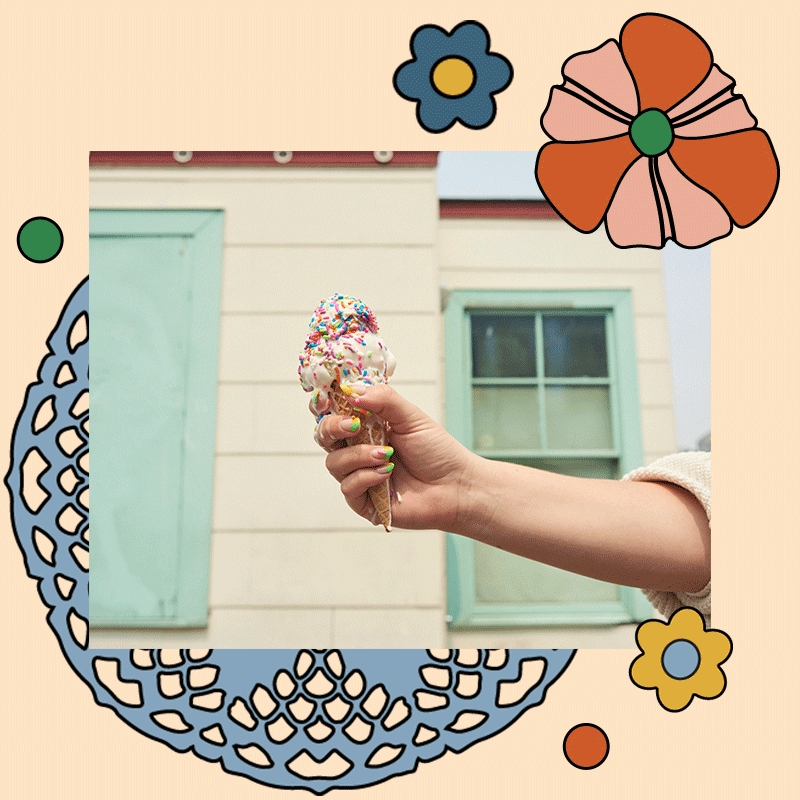
Let me start off by saying that I have a sweet tooth. A major chocolate lover. I discovered Ample Hills a couple years ago on one hot, fateful summer day and got the Chocolate Milk & Cookies flavor — I became obsessed. It is the best flavor.
Flash forward to last summer during COVID. I was in a new relationship — my quarantine bae — and there wasn’t much to do other than walk around. We happened on Ample Hills, and it soon became a Sunday ritual. We’d end the week with a walk and ice cream, either at the West Village or Brooklyn location.
I was in the city during lockdown, but if my mom didn’t live here, I would’ve been one of those people to leave during the height of it. My sister and I stayed with her and we were here through it all — the ups and downs, and now, the reemergence of New York City. I didn’t officially move here until 2016 (my first memory is from sixth grade, when I began to take annual trips from Allentown, Penn., to get a cut at a curly-hair salon), but I think I always knew I wanted to live in New York.
I’m in a studio in Chelsea now, but my boyfriend no longer lives in the city. We were driving out to his place one day recently when we passed by Ample Hills, and he immediately pulled the car over so we could get ice cream before we left (I also bought us Ample Hills T-shirts to commemorate our love for it). I love how this shop has inadvertently become a staple in our relationship. But more than that, I love the way ice cream makes me feel. In the past, I’ve had issues with body acceptance and I’ve experienced disordered eating — and that’s why I feel really powerful when I’m able to, on a Sunday evening, decide to eat ice cream. There was a time in my life when I wouldn’t have allowed myself to eat the way I wanted or to consume something like ice cream that truly brings me so much joy. So the fact that I can go to Ample Hills and enjoy ice cream is a reminder just how far I’ve come, how much I’ve grown.
Z
Artist, 26 Location: Maria Hernandez Park, Bushwick, Brooklyn
The first time I ever pulled on a pair of roller skates wasn’t that long ago: December 2019, a month before I made the move from New York to Los Angeles. A few months later, I bought my first pair of skates — holographic with sparkly blue wheels that made me feel like a little kid again. But then COVID hit, and the city went on lockdown where there was nothing for me to do except to wake up, lace up, and skate for hours.
Living in LA was hard: I was in a toxic/racist roommate situation, I didn’t have any friends I could count on, and I felt incredibly alone and depressed. But I found that skating uplifted me, putting me in a better head space. As an artist, I’ve always been able to express myself through art, but by roller skating, which is inextricably linked to music, I’m able to channel how I’m feeling through my movements. It became an avenue of self-discovery and self-expression (one of my favorite parts is dressing up in glittery, celestial, fairy-like looks that are cute but also sporty).
I moved back to New York last June to be around family and friends (I was born in Harlem, grew up in Queens, and then lived in Brooklyn). Returning to Bushwick also meant returning to Maria Hernandez Park, where I grew up going to all the time. I remember knowing all the kids, and in turn, all the neighbors knew who I was. There was a sense of community that’s missing in today’s digital age. Now, being at the park as a roller skater, I feel that connection to my community again. Roller skating has not only brought me confidence, it’s also allowed me to get to know my neighbors, especially the kids, who like to ask about it.
Skateboarders at the park told me they’ve noticed a recent crop of roller skaters, which is beautiful — I had no idea I would influence and inspire others to pick up their skates. When I see a new face, I welcome them to skate with me, so they know they’re not alone. I know how much joy skating brings me, so seeing others attempting to find that same joy makes me really happy. That’s also why I launched a skate community called Sk8mamis, a space for womxn and femme-identifying non-binary people, because I hadn’t found one that was welcoming or inviting or safe. Roller skating should be fun and you shouldn’t have to worry about being harassed or touched without your consent. As soon as I realized I could do something about it, I, along with the help of others, created this dream community together.
I remember the moment like it was yesterday: My mom and eight-year-old me standing in front of the building of her first apartment on Troutman Street in Bushwick. She was crying tears of joy because she finally had a place of her own to call home. And she was so excited to give me my own room, which she decorated with Rugrats-themed curtains (my favorite). That single memory is what inspires me to make it on my own, because it’s something that my mom strived to achieve. I’ll never forget it.
That was after spending about a year in a homeless shelter. At the time, I didn’t understand what was going on. We had a bed and shared a kitchen and bathroom with others. But was this our home? Why didn’t we have our own place? And why couldn’t we stay with grandma? My mom, a single parent, was young — in her 20s — and she was set on carving her own path. I was born in Williamsburg and lived there until the age of five before we moved to my grandmother’s at Marcy Projects in Bedford-Stuyvesant. We were there until my mom and my aunt had a falling out, and we packed up our things and headed to the shelter.
We stayed at the apartment on Troutman for two years — until my mom lost her job and we had to move back to my grandmother’s. In an interesting turn of events, when the pandemic hit, I also moved back to my grandmother’s. I had been living in an apartment with roommates but made the decision to go home during lockdown, help my family out, and then get my own place once it was all over. What I loved about it was spending quality time with my family, getting reacquainted with my grandmother, and listening to retellings of childhood stories as an adult. It’s beautiful to see the parallels in my mom’s life and mine — we’re two very different people, but we share the same drive that keeps us going no matter what.
Still, moving back home triggered some childhood traumas (my rocky relationship with my grandmother, memories of my mother and father), which prompted me to start therapy and to heal from those wounds. Now, I communicate better. And during the holidays last year, we were all communicating and having fun — I never dreamed we would ever get to that place. I lost my grandmother a month ago, and I’m happy that I have those memories of us I can cherish, that I made the decision to go back home.
I moved out this January into my own apartment on Knickerbocker Avenue, which is where my mom and I used to frequent when we lived on Troutman. All the mom-and-pop shops are still there, which is unbelievable. It’s definitely a full-circle moment — eight-year-old me would be so proud.
Like what you see? How about some more R29 goodness, right here?
Refinery29 is proud to partner with Aerie, a brand dedicated to celebrating real voices and real bodies. Here, plus-size model and Henning founder Lauren Chan pens a heartfelt personal essay about what it was like to experience body image anxiety during the pandemic, and the lessons she took away from it.
First, a disclaimer: I don’t usually talk about weight and body image, because I’m a firm believer that the size of our bodies has nothing to do with our value as human beings — so much so, that I’ve spent my career as a plus-size model, fashion writer/editor, and brand founder fighting for size inclusion in the fashion industry and, ipso facto, for women to remove the learned link between their weight and self-worth. But I still fall victim to bad self-esteem spirals (I’m human! With nuance! Who falters!), especially when I gain weight, and the pandemic has been full of spiraling.
During the past 17 months, I’ve gained almost exactly as much weight as the average American. The American Psychological Association also found that 61% of Americans reported “undesired weight gain” during the pandemic. The numbers don’t surprise me: I’d be straight-up mind-blown if we didn’t all gain a little weight while trapped in our houses, stressed about our health, well-being, livelihood, relationships, and, well, the very fabric of society as we know it. Through that lens, what’s a little extra belly fat in the grand scheme of things? We survived a pandemic, and it was our bodies that got us through this historically horrific time alive.
And yet, I felt anxious about my body the whole time. My general mood declined, there were instances of negative self-talk, I practiced restrictive eating, I downed a little too much wine, I picked at my skin, I became upset after spending too much time on social media, and I even contemplated skipping modeling work for fear of having my body ridiculed. In hindsight, I should have sent my prefrontal cortex a cease and desist the second these behaviors appeared, but because they didn’t happen all at once — they snuck up on me — I spent several regrettable months in a tailspin.
I ended up putting some of my go-to feel-good habits into play, like reducing as many stressors as possible (spending time away from work), investing in bodywork (reflexology, acupuncture, and massages), limiting screen and mirror time, and hanging with my animal pals outside. My usual solutions helped a little, but I was discouraged to find that they didn’t all-out cure my anxiety like they had in the past.
And that’s because, I discovered, my pre-pandemic remedies for body image anxiety largely hinged on a mindset of body neutrality wherein I didn’t really think about my size. I had a life before lockdown: In 2019, my typical week could consist of morning park sessions with my dog and husband, 60-plus hours of work on my business Henning, photoshoots for my job as a plus-size model, a side-hustle as a micro-influencer, potential work travel, dinners socializing with my friends, managing the rest of my life in my spare time, and maybe even a weekend getaway. When that all went away, I lost the distraction part of my body image equation — the pandemic had taken a toll on my relationship with my body, and I slowly began to realize my body image had been slipping.
One morning, I decided to talk to my therapist about my new pandemic-fueled body image anxiety. They asked one question that really resonated with me: How would I comfort someone else having this experience? Better yet, how do I think I deserve to be comforted? Something clicked. Over the next few weeks, I tried this trick on repeat. First, when my clothes didn’t fit, then when I didn’t want to go to a modeling job, or when I felt anxious before seeing friends or family for the first time since the Before Times. It worked every time. Treating myself with the unconditional love and motivational care that I insist on giving others made me feel immediately soothed.
I was taken aback by my experience — I thought I already loved myself, period. But I’m learning that even though I have strong, positive beliefs about body and size, the voice in my head isn’t always the most caring or considerate. That’s likely because I have a lot of work to do on my self-image (hi, workaholic with an achievement complex here). Plus, body image isn’t something you “fix” once, it’s a relationship with yourself that needs to nurtured. For now, I’m trying to flex this new muscle (with help from others who have mastered this habit, like Kendra Austin and Bunny Michael).
I used to dismiss advice about talking to your inner child or speaking affirmations in the mirror because I didn’t understand exactly how to do it, which is why I’m leaving you with a few real examples of how I’ve used my inner voice to ease my body image anxiety:
Anxiety: I’ve gained weight and am feeling uncomfortable in my body because my clothes don’t fit. I should monitor what I eat until I can wiggle back into my jeans. Remedy: Your body got you through a global pandemic — can we please give it a great, big hug and a round of applause? It’s completely understandable to feel physically bothered by pants that cut into your stomach, but I think this sounds like a great reason to get those new jeans you’ve been eyeing.
Anxiety: I don’t want to go to set and work as a model today because the client might be mad that I’ve gained weight. Remedy:Oof. This feeling sucks. You are allowed to think it sucks. But — hear me out — I think you should thank yourself for doing sometimes-uncomfortable work in order to make a living. Plus, someone might see these images while shopping and feel better having seen a body type like theirs. How about you try to go today and if you hate it, don’t book this client again?
Anxiety: I feel nervous to see friends and family that I haven’t seen since the Before Times. What if they notice my weight gain and judge me for it? Remedy: You deserve gentle, loving, patient relationships — and you deserve to talk to yourself in that way, but today I’m getting straight to the point: Your loved ones don’t think that your appearance has anything to do with who you are and why they love you. After all, do you care what they look like? Exactly. Enjoy yourself and try to focus on conversation and connection today.
Anxiety: I can tell that I’ve gained weight in my social media posts. Maybe I should start Photoshopping myself to appear smaller. Remedy: I know it’s hard to put yourself out there, but have you done inventory lately on what your community has been commenting and how your posts have been performing? There are 99% positive comments and your recent swimsuit posts performed 600% better than average. The takeaway: Your community is here for transparency and real talk — keep it up.
Like what you see? How about some more R29 goodness, right here?
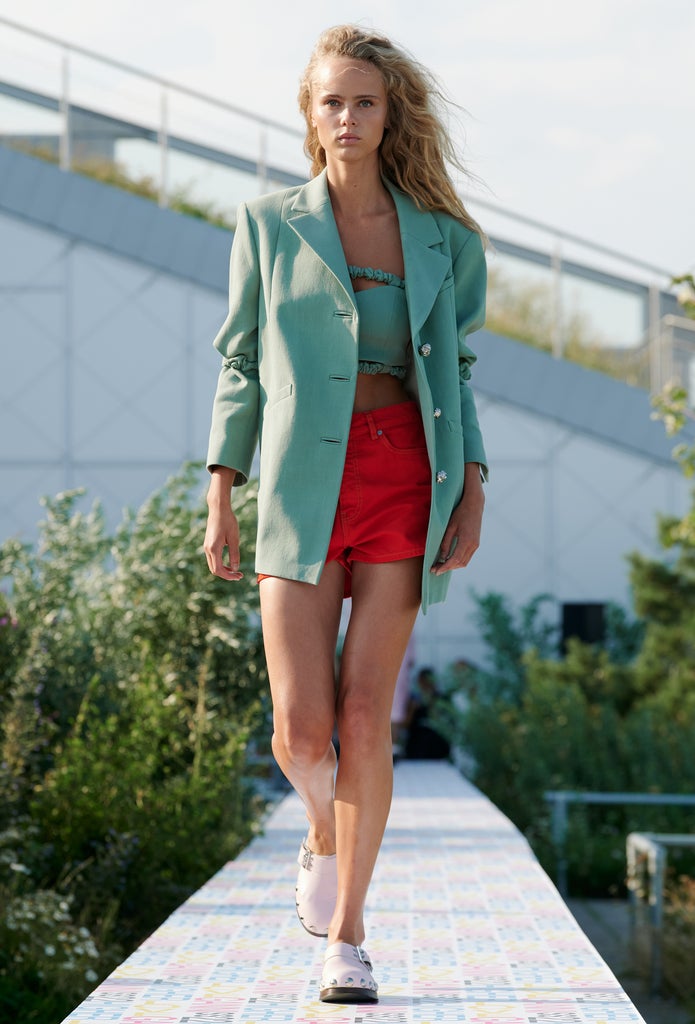
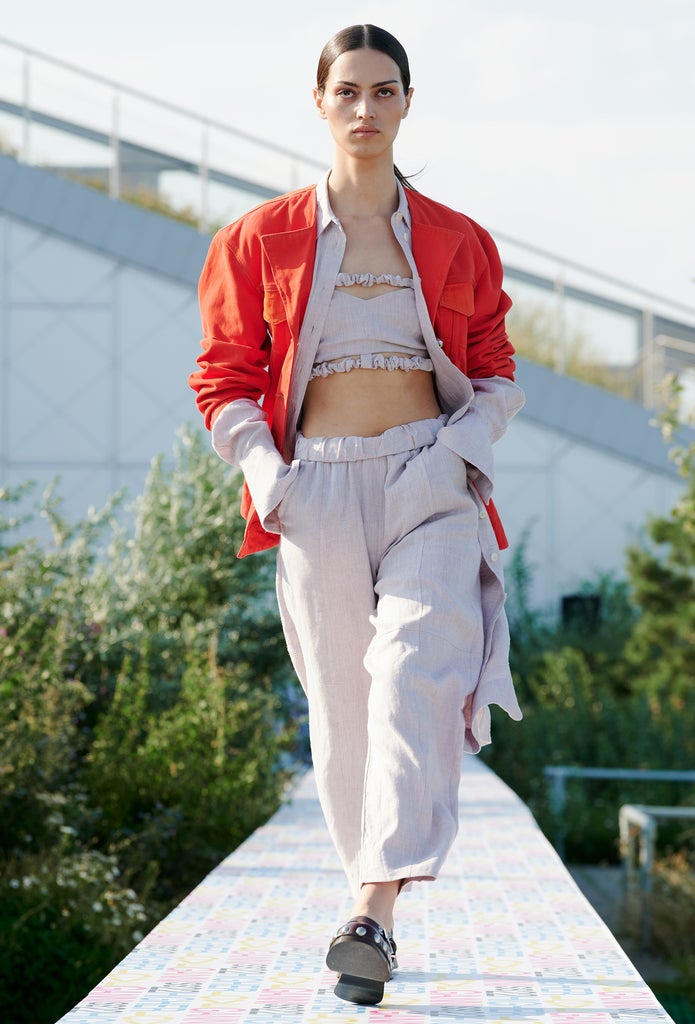
Copenhagen Fashion Week has fast become one of the most popular emerging fashion showcases — and for good reason. The Spring 2022 edition wrapped up last week, with brands like Ganni, Cecilie Bahnsen, and Stine Goya (once again) defining the style of the city with brightly printed dresses, an abundance of cool denim, and an emphasis on volume in the form of oversized puff sleeves and dramatically cascading dresses.
Even though over the years, we’ve come to associate the Danish capital with all that is cool and effortless, Copenhagen is the site of a major aesthetic evolution right now.
“The Copenhagen fashion scene has changed a lot from when I founded the brand in 2006,” designer Stine Goya tells Refinery29. “Back then, the Scandinavian style was pretty much synonymous with minimalism — muted palettes, slick shapes, and classic finishes — but now the vibe is completely different.”
You need no further proof, that the “Copenhagen fashion scene [is] much more fascinating and vibrant,” than Stine Goya’s latest show which featured mismatched colors and even more prints. While the label has been showing a variety of patterns since its inception, the difference this season was in the intensity of hues and the way in which different prints were combined. Think: A single look featuring three abstract prints — a pastel swirl vest, a geometric-embellished sweater vest, and a skirt covered in painterly strokes. Elsewhere there were bold checkerboard knits combined with ditsy flowers.
While Goya attributes the evolution of the Scandi-chic style to the variety of different brands that have entered the scene in the last 15 years, she also points to how now, a year and a half after the pandemic ushered everyone indoors, there is “a hunger for more playful and joyous design.”
Ditte Reffstrup, one-half of the husband-wife duo behind Ganni, agrees. “The new collection is an antidote to locking down and staying home,” she says. “It’s clothes to dance in, to be seen in — slinky, silky dresses and bra tops… I think a lot of us are looking forward to dressing up again.”
We like to dress up, but we need to be practical.
Barbara Potts, Saks Potts
For this collection, the brand that has become synonymous with little leopard dresses and colorful, cutesy knitwear showed ultra-wearable pieces, with unexpected details that elevated styles beyond basics. Options like puffy elasticized straps, fishnet fabric skirts, and ruffled corset tops were mixed in with boxy shorts, crochet tops, and bodycon ruched dresses.
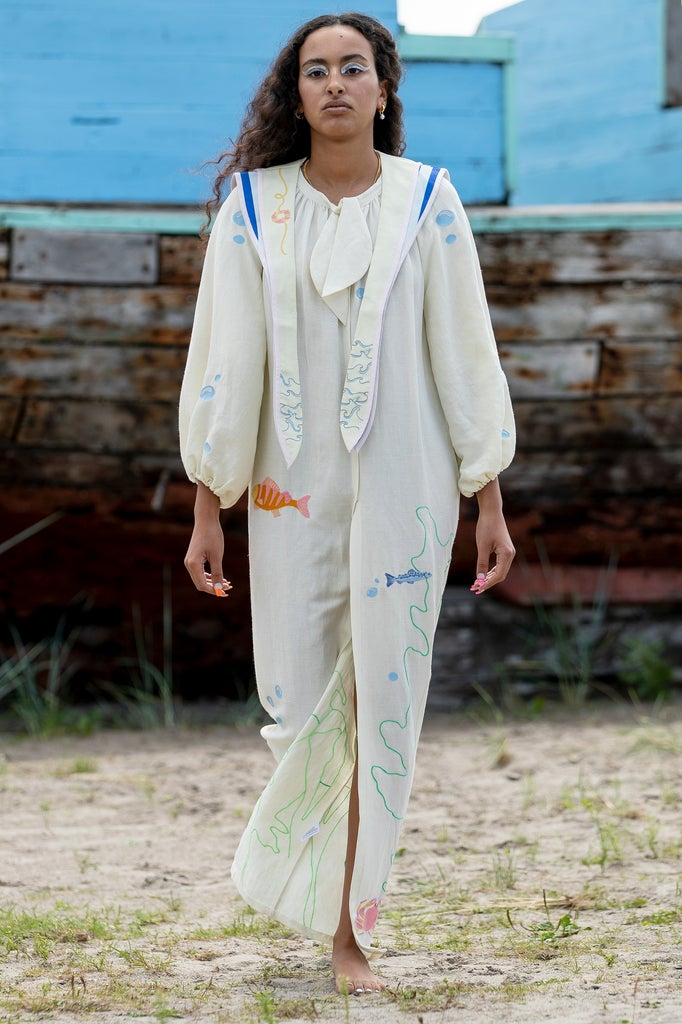
As the fashion world tunes into the Copenhagen scene with increasing ardor, there is little sense that the creators are looking to betray their roots. While CFW designers embraced a more dressed-up look season, the casual and uniquely Danish pairings that have long defined the style coming out of the city remained. For example, Helmstedt sent models down the runway in pretty pastels but with bare feet. Elsewhere, at the shows, influencers and the style set chose flat sandals, loafers with chunky socks, and comfy sneakers over heels. That’s an idea that recently, Cecilie Bahnsen, one of the city’s favorite household names , has been honing in on, too.
“There is a relaxed and effortless approach to fashion that I believe makes Danish style relatable and desirable to everyone,” the designer, who is known for her flouncy silhouettes, says. “The girls in the studio will pair one of our couture fil-coupe puff sleeve blouses with a pair of gray sweatpants and the Suicoke sandals, and then the next day, wear one of the gowns with a beloved pair of sneakers they have had since high school. It’s the mix of old and new, comfort and couture.”
Whereas heels and over-accessorizing with mini printed dresses was the look of the past, this season, CFW designers gravitated to minimal practically with cool details — be it fishnet textures or scrunchie-like straps seen at Ganni or the sheer polo shirts worn underneath dresses at Cecilie Bahnsen.
There is a relaxed and effortless approach that makes Danish style relatable and desirable… It’s the mix of old and new, comfort and couture.
Cecilie Bahnsen
“Copenhagen style is driven by gut instinct — and, of course, the weather. It’s really all about feeling good, pairing comfort and practicality with self-expression,” says Goya. “Copenhageners don’t shy away from risk. It is very much about mixing without necessarily matching and informed by a vibrant and active lifestyle.”
Despite a distinct evolution, there is a through line. “It’s very important with all pieces that we make, that there’s always that practical element,” says Barbara Potts, one-half of Saks Potts, known for its vibrant leather coats and holographic sets in shades of neon green and orange. “When you live in Copenhagen, you have to be present because we bicycle around and we are just too practical. We like to dress up, but we need to be practical… The typical Copenhagen girl loves to move around, be comfortable, and go places.”
There are now entire brands on the official fashion week schedule that represent those practical ideals. Take, for example, Rains, which was founded in 2012. Like the name suggests, all items are rainproof. “True functionality is rooted in logic and simplicity. And our minimal and functional designs reflect those values,” explains the Danish brand’s head of design Tanne Vinter. “Ask many around the world to describe the Scandi aesthetic, and most will mention clean lines and pared-back colors. But today, Copenhageners play with those archetypes and create very individual looks.”
Copenhagen style is driven by gut instinct — and the weather.
Stine Goya
Like the new collections shown at the latest Copenhagen Fashion Week would suggest, the new aesthetic is a mixture of cool basics that are as wearable are they as functional, with high-fashion twists that make them feel more dressed up than your regular comfort wear.
“The Copenhagen aesthetic embodies the utilitarian and comfort that our garments encapsulate,” says Bahnsen. “There is the handcrafted detailing and couture fabrics, but, when Monday comes around, we still throw on these dresses with an old pair of tennis shoes, jump on our bikes, and tie up the side of the gown with a hair tie so it doesn’t get caught in the spokes of the wheel.”
Like what you see? How about some more R29 goodness, right here?