सोशल मीडिया पर अक्सर ऐक्ट्रेसेस को ट्रोल्स का शिकार होना पड़ता है। चाहे वे कैसी भी तस्वीर शेयर करें, लेकिन ट्रोलिंग की आदत से मजबूर लोग उन्हें किसी ने किसी बहाने से अपना शिकार बना ही लेते हैं। हालांकि, अगर ट्रोल्स अपनी हरकत से बाज नहीं आते, तो सिलेब्स के फैन्स भी ऐक्शन में आकर उनकी आलोचना करने और अपने फेवरिट ऐक्टर-ऐक्ट्रेसेस का बचाव करने में पीछे नहीं रहते हैं। ऐसा ही कुछ निया शर्मा के केस में भी हो चुका है। दरअसल, एक पेज ने निया शर्मा की फ्लोरल लहंगे में तस्वीर शेयर की थी। फोटो में निया को वाइट कलर के लहंगे में देखा जा सकता है, जिस पर कलरफुल फ्लोरल प्रिंट था। इस प्लीटिड फ्लेयर्ड स्कर्ट पोर्शन के साथ निया ने पर्पल कलर का ब्लाउज पहना था, जिस पर गोल्डन थ्रेड से वर्क किया गया था। इसकी स्लीव्स के एंड्स पर चौड़ी गोल्डन पट्टी भी लगाई गई थी। लहंगे के साथ नेट की चुन्नी थी, जिस पर ब्लाउज से मैच करती ही गोल्डन ऐंड पर्पल रंग की बॉर्डर स्टिच की गई थी। करिश्मा के लहंगे से कंपेयर इंस्टा पेज ने निया के लहंगे को करिश्मा कपूर के लहंगे की कॉपी बताया। लोलो ने एक फंक्शन के लिए सब्यसाची मुखर्जी लेबल का वाइट स्कर्ट विद फ्लोरल प्रिंट का लहंगा और उसके साथ एम्रल्ड ग्रीन कलर का ब्लाउज पहना था। इस ब्लाउज पर बेहद बारीक गोल्डन एम्ब्रॉइडरी की गई थी और इसे ही लहंगे व दुपट्टे की बॉर्डर पर भी दोहराया गया था। लोलो ने इसके साथ हाईनेक चोकर नेकलेस और मांगटीका लगाया था। इसमें वह किसी राजकुमारी लग रही थीं। निया का लहंगा भी बिल्कुल इसी से मिलता-जुलता था। फैन्स को नहीं भाया कंपेयर करने का अंदाज दोनों ड्रेसेस को कंपेयर करते हुए पेज ने जिस तरह से निया को ट्रोल करने की कोशिश की, वह ऐक्ट्रेस के फैन्स के गले नहीं उतरा और उन्होंने कॉमेंट बॉक्स में अपना गुस्सा जाहिर करना शुरू कर दिया। इसी के साथ उन्होंने निया के फेवर में भी कॉमेंट करते हुए उन्हें 'सुंदर ऐक्ट्रेस' बताया। एक यूजर ने तो यह तक लिख डाला कि 'मैं भी कॉपी लहंगा लेने की सोच रही हूं, कहां मिलेगा? आखिर इसमें बुराई क्या है?'
Black women have long been overlooked and underserved across all industries, an injustice that is finally being brought to the forefront, with Black women leading the movement against racial inequality. To honor just how truly essential Black women are, Unbothered has partnered with Target to share the stories of those who are fighting for inclusivity, challenging stigmas, and prioritizing mental health — stories that shed light on their incredible strength, ambition, and humanity.
Erin Carpenter always knew she wanted to dance — from a young age, she loved to move her body. So it came as a surprise to no one that she ended up building a career around the art form, going on to land a gig as a Knicks City Dancer at 24 years old. But as it turns out, dance was simply a stepping stone to Carpenter’s true calling, as the founder of Nude Barre, a line of undergarments working to make the fashion industry more inclusive.
Nearly 20 years ago, when she was a high school senior, Carpenter was told she couldn’t take classes at the Kennedy Center Dance Theatre of Harlem’s professional residency program because she wasn’t in “uniform.” She didn’t have — nor could she find — flesh-tone tights that matched her skin tone (they were either too light or too dark).
“[Sitting out during a class] was so embarrassing because I had to sit in front of the class and everyone knew you did something wrong,” Carpenter says. “I asked the teacher what to do [so I could participate next time] and she told me to dye my tights and shoes to match my skin. I thought that was ridiculous.”
From then on, the only way for her to take classes was to paint foundation on her tights and shoes. It wasn’t until her Knicks City Dancer days — from 2007 to 2009 — that Carpenter had the idea to turn her experience into an opportunity: a line of flesh-tone undergarments to match every skin tone. She asked dancers on the team and other industry friends to offer feedback on her product and to lend advice on tones. From there, she selected 18 shades and eventually finalized 12 that ranged from light to medium to dark skin tones. After years of research and development, she officially launched Nude Barre in 2011.
Nude Barre offers tights, thongs, bralettes, and fishnets for all women (and tights for children) in sizes that range from XS to XXL and in a uniquely extensive shade range that can’t be found anywhere else (purchase swatches or take the skin quiz to find your shade).
“When brands aren’t inclusive, it ultimately boils down to systemic racism,” says the 35-year-old Washington, D.C native. “They don’t care about diverse customers so they don’t make products for us, which is why you see such a surge of Black-owned businesses that have launched things that cater to women of color.”
Carpenter isn’t alone in her endeavors. According to research by American Express, from 2007 to 2018, the number of Latina and Black women-owned businesses grew faster than the average rate for businesses owned by women of color. But this year, with the pandemic and civil rights movement, all businesses are faced with unprecedented challenges. Carpenter, who manages a team of five, says there have been both good and bad moments.
“On one hand there’s been an uptick in sales and we’re mentioned in conversations surrounding Black-owned businesses — we’ve gotten business from more white women and that’s been great,” she says about the impact of the Black Lives Matter movement. “But on the other hand, because of the pandemic, we’ve had supply chain issues. Many manufacturers had to shut down for a period of time and that greatly affected business.”
Whether the Black Lives Matter movement will continue to shape the landscape of fashion for the better, Carpenter says it’s too early to tell.
“It will be interesting to see the shift,” she says. “[The movement] could also be a trend, so it’s hard to say what’s going to happen. But I feel hopeful that people are taking the importance of Black businesses seriously.”
While Carpenter says she hasn’t encountered blatant racism, she has experienced difficulty with fundraising, and she believes it’s because she’s a Black woman. According to a 2016 survey by the Federal Reserve, Black-owned businesses, compared with white-owned firms, are less likely to receive approval for financing. And according to PitchBook, only 2.8% of capital in 2019 went to U.S.-based female-founded businesses. It stands to reason that of the 2.8%, an even smaller percentage is going to women of color.
“Raising traditional funding is hard for Black women,” Carpenter says. “The [giant social media platforms] of the world [have it easier] because people invest in people who look like them. And yes, there are new Black venture capitalists now, but it’s not nearly enough [to support] all the Black female founders.”
Carpenter believes generational wealth is a large factor, too. “If you want bank loans, you need assets, but most Black women don’t have assets to leverage for a loan,” she continues. “It’s [one of the] the biggest factors in what causes Black businesses to grow slower than other businesses.”
But failure isn’t a part of Carpenter’s vocabulary. She’s determined to run a profitable business, while reminding herself of the banner moments that have led to her success. That’s what keeps a smile on her face. For instance, she loves reflecting on how a big-time talk show host was one of her first celebrity fans. Another hallmark moment? Seeing arguably the most famous tennis champ in the world wear her tights at various matches (she is now an investor for the brand and continues to offer support).
Right now, Carpenter is focused on keeping a level head, and she expects a bright future for her brand. For the upcoming quarter, she plans to launch Nude Barre in new retailers and bridal stores, and she dreams of one day expanding the intimate offerings to include shapewear and camisoles.
“I want Nude Barre to be a big brand that offers undergarments in diverse skin tones for all women,” she says. “My goal is to shed light on the struggles women have when trying to find flesh-toned apparel. Brands aren’t offering them, but we have the solution.”
Like what you see? How about some more R29 goodness, right here?
On Monday, tennis' finest assembled in Flushing, New York, for the long-awaited 2020 U.S. Open. And while we’re all rooting for Serena and Venus Williams to dominate the nine-day sporting event as they’ve done in the past, it’s not just the tennis action that’s getting us pumped up for the games. Instead, from now until September 8, we’re focusing our attention on the influx of tennis style inspiration that coincides with the arrival of the Open — more specifically, the tennis skirts.
Over the last year, tennis fashion has seen an uptick in popularity, with retro styles from Sergio Tacchini, Tory Sport, and Lacoste making waves both on and off the court. Even Venus Williams joined in on the action with her brand EleVen’s tennis wear line. Photoshoots now frequently take place on the sport’s signature green surfaces, with Chloe x Halle recently taking to their backyard court to shoot their Fendi Peekaboo bag campaign and Instagram influencers flocking to nearby public courts to garner an aesthetically pleasing shot. In fact, the rise of tennis fashion is so significant that back in June, Lyst reported a 33% increase in demand for pleated tennis skirts in just one month. Now, the real tennis style inspiration is here.
Click ahead to shop this season’s most stylish tennis skirts, from traditional tennis whites to bold, Williams-approved alternatives, all in honor of this week’s opening ceremony.
At Refinery29, we’re here to help you navigate this overwhelming world of stuff. All of our market picks are independently selected and curated by the editorial team. If you buy something we link to on our site, Refinery29 may earn commission.
Retro Tennis Skirts
If you're looking to take a throwback approach to tennis fashion this season, these are the styles for you. Just throw on some tube socks, a varsity sweater, and a pair of chunky, white sneakers, and you'll be all (game) set (match).
Tory Sport Tech Twill Pleated Tennis Skirt, $, available at Nordstrom
Sergio Tacchini Pliage Skort, $, available at Sergio Tacchini
Modern Tennis Skirts
From mesh fabrics to fresh silhouettes, tennis skirts don't all look the same anymore — and these modern styles by Outdoor Voices and L'Etoile Sport are proof.
Outdoor Voices Court Skort, $, available at Outdoor Voices
FP Movement Schooling You Shorts, $, available at Free People
L'Etoile Sport Stretch-Jersey And Pointelle-Knit Tennis Skirt, $, available at Net-A-Porter
White Pleated Tennis Skirts
For those of you who are just now introducing tennis styles to your end-of-summer wardrobes, this is the perfect place to start. Not only does a traditional, white tennis skirt look great on and off the court, it'll also fit right in with the TikTok fashion scene.
American Apparel Gabardine Tennis Skirt, $, available at American Apparel
Lacoste Sport Ultra Dry Pleated Tennis Skirt, $, available at Lacoste
Colorful Tennis Skirts
If your style goal is to stray as far away from the traditional tennis look as possible, look no further than these colorful alternatives by the likes of Girlfriend, Gil Rodriguez, and Nike.
Gil Rodriguez Green Terry Tennis Skirt, $, available at SSENSE
As plus-size fashion continues to grow exponentially — the market is estimated to be worth $24 billion by the end of 2020 — the demand for clothing above a size 16 is more apparent than ever. But as the coronavirus pandemic continues to challenge designers and the current fashion landscape, many are beginning to realize just how valuable this market and community are.
While retailers have been seemingly more receptive to size inclusivity in the last few years, luxury designers have only scratched the surface on the topic: A report published by InStyle in February revealed that only 22% of designers that showed at New York Fashion Week produced up to a size 20 or above. (That number is largely influenced by brands like Chromat and Tadashi Shoji, who have long led the charge for size inclusivity in luxury, too, rather than the collective industry.) But the key to a size-inclusive future is not only through demanding change from pre-existing brands. Rather, it is through preparing the next generation of game-changers to be inclusive from the start, while they are still in school. That requires an increase in size-inclusive education, a topic that is still heavily lacking at many fashion colleges.
“The conversation around plus-size or fat fashion has been seen purely as a social justice issue and an activist issue,” says Ben Barry, chair of fashion at Ryerson University in Toronto, which offers a fashion study program centered on inclusivity of size, gender, and race. “This is a business imperative for the fashion industry.”
While plus-size fashion is being addressed more within school curriculums, most institutions are leaving it as an alternative choice of study, should a student want to focus their final project on it, rather than stressing the importance of plus fashion and the vital role it plays in the future landscape of the industry. This continues to fuel the separation between straight and plus-sizes, while sending the message that plus is a separate and lesser entity.
Meanwhile, according to every educator interviewed for this piece, students crave inclusivity more than ever.
“I feel like creativity and following what you are passionate about was encouraged at my school, but not so much size inclusivity,” says Ian Harris, a former apparel design major at the University of Minnesota Twin Cities, who graduated last year. “Nothing was ever strictly covered in regards to plus-size fashion… but if we wanted to make something in plus-sizes, they would help us work through those potential fit problems.”
He adds, “It’s annoying that if I wanted to make plus-size womenswear, and I needed to drape something or get an accurate fit without a model, I couldn’t really get that.” Cesar Cummings, an L.A.-based designer, had even less help when attending a smaller fashion school in California. In fact, after getting the dean’s approval to design plus-size in his courses, Cummings got pushback from a professor, who told him to just “manufacture clothing” during one of his classes. (Cummings fought back and eventually got to design the plus-size clothing he wanted.)
Many schools — including the Moore College of Art & Design and Kent State University — allow students to focus on plus fashion in their design classes or final projects if they have the desire to do so, and offer assistance in various ways should the student request it. But this fails to make inclusive fashion a core element of the curriculum. Only offering support if a student expresses interest in plus makes straight-size designing the default, and many young designers still learning the ropes of the industry will likely cling to the more standard option of a size 6/8 dress mold.
The COVID-19 pandemic has made the need for plus-size curriculums more apparent. As many schools — including the Fashion Institute of Technology — switch to a fully remote or online-first education system for the fall 2020 semester, students have less of an opportunity to explore the market unless it’s worked into classes. While plus-size mannequins may be available in-person at selected institutions, students may have a hard time finding one to have at home, making it even more difficult to pursue plus-size designing.
On the other hand, virtual schooling can lend itself to a more inclusive education. Virtual seminars and panels can allow students to connect with plus-size fashion experts that they may not have been able to in-person. 3-D technology allows students to design for a wide array of body types, rather than just a size 6 or 14 mold.
All to say: While there’s no lack of opportunity available, it’ll require forward-thinkers to prioritize body diversity in a way that hasn’t been done before.
So, what would a truly inclusive curriculum look like in practice? Best intentions aside, no one has quite cracked the code on how to normalize size inclusivity into their curriculum. While designating instructors to assist those who want to design for above a size 14, as many schools do, can be the first step, more needs to be instituted to show the important role that size inclusivity plays in the future success of this industry.
Jennifer Minniti, the chair of Pratt University’s fashion department, tells Refinery29 that the school is currently rethinking and redesigning its entire curriculum around size inclusivity, sustainability, and gender identity. She says she sees more value in injecting size inclusivity into the program rather than offering plus-specific courses. “We’re trying to find a way to provide critical study in the core curriculum, so where it should really underpin the core curriculum,” Minniti says. “So our students can become agents of change and make serious change in the industry.”
In 2018, the Fashion Institute of Design and Merchandising in Los Angeles brought on Nick Verreos — former contestant and current producer on Project Runway — to be co-chair of its Fashion Design program, hoping he would shake things up and diversify the curriculum. Though much is still in the works at FIDM, Verreos says that students are first taught the foundation of design and then how to translate that on different body types, stressing the difference between a size 18 body and a size 6. “We’re really considering offering [plus-size specific design] electives,” Verreos says. “And we do hear from a lot of manufacturers and companies where a lot of times the young entry-level assistants have come into those kinds of companies [not knowing how to design for plus].”
Lisa Hayes, the Fashion Design program director at Drexel University in Philadelphia, tells Refinery29 that they have been incorporating size inclusivity into their program for about the past decade, bringing in plus speakers and educators to show their students the possibilities available to them. Hayes credits much of this to the smaller size of the program, allowing them to jump on different initiatives early such as plus fashion or adaptive clothing for those with disabilities.
At FIT in New York City, the need for plus-size fashion education became apparent when the school put on a forum titled “The Business of Curves” in 2017 featuring plus supermodel Emme. With 500 students in attendance, the desire for more education on the topic was evident, and so Steven Frumkin, Dean of the Jay and Patty Baker School of Business and Technology, put together a handful of courses in their technical design area to satisfy those students. Pre-pandemic, FIT had continued to host inclusive events and hired a Chief Diversity Officer to push the conversation forward. The program has also incorporated 3-D design into its courses, as have other schools like the University of Minnesota Twin Cities, that allow students to dress for more body types and sizes.
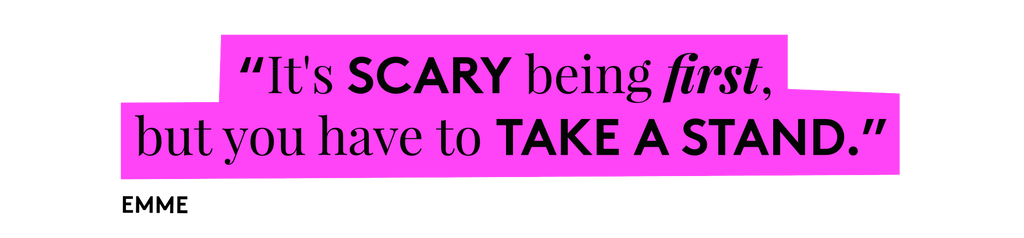
Prior to helping change the narrative at FIT, Emme launched Fashion Without Limits in 2013, an initiative co-founded with Syracuse University’s School of Design professors Jeffrey Mayer and Todd Conover, to teach inclusive design. Fashion Without Limits has since expanded greatly, becoming a four-year program offered by Syracuse. “Every time innovation and newness and change happens within a design program to be more inclusive, everyone wins,” Emme tells Refinery29. “It’s scary being first, but you have to take a stand.”
Former Ford Model Angela O’Riley has created a similar program for high schoolers called The Curvy Lab. Conducted at The High School of Fashion Industries in NYC in 2018, it serves to teach young hopefuls about inclusive designing before they even entered college. “When you’re a designer, you have to be able to make something that’s beautiful for whoever your customer is,” O’Riley explains. “So we’re retraining the eyes of these kids to find what’s beautiful in whoever is in front of us or whoever our customers are, and we’re starting with the size 18 curvy mannequin, because that’s where the industry is, but that we’re not limiting ourselves to that.”
The success of Fashion Without Limits and The Curvy Lab raises a question: Would offering plus-specific design courses and programs, rather than incorporating them into the existing curriculum, in fashion colleges be the most beneficial route? While a majority of the educators interviewed said no, Susan Moses — author of the book The Art of Dressing Curves and a helper in FIT’s change toward inclusivity — thinks otherwise. “There are so many aspects of designing for plus that are different,” Moses says.
Moses makes a valid point: Fit is essential when designing for plus bodies, and too often, brands grade up from a size 8 or 10 without taking this into account. Weight can be added to the body in many different ways making one size 18 woman’s shape different from another’s. If young designers are unaware of the rigors and intense amount of training and experience needed to properly fit fat bodies, they could be set for failure.
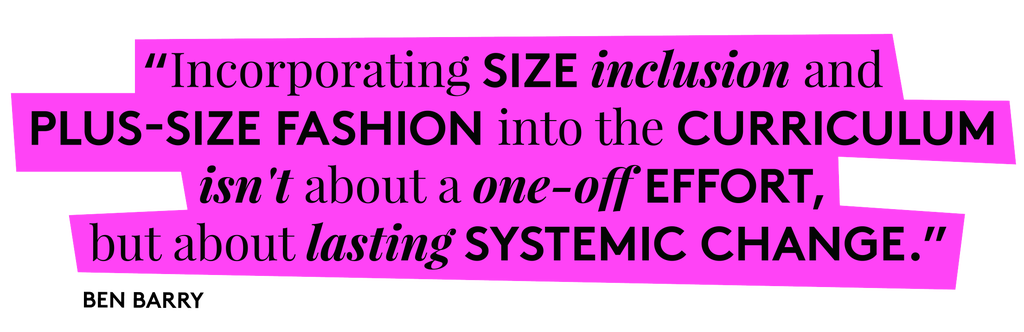
A better question may be this: Why not normalize size inclusivity in technical classes while also offering plus-specific ones for students who want to expand in that market? “Incorporating size inclusion and plus-size fashion into the curriculum isn’t about a one-off effort, but about lasting systemic change,” says Barry. “It’s about transforming an entire educational system, not just offering it off for your elective.”
Before students at Ryerson even get to design, they are taught — through readings, documentaries, guest speakers, and coursework — about fat activism, as well as other topics like Black liberation and marginalization. They are taught about stereotypes regarding marginalized bodies in the industry, teaching them the significance and importance of inclusive fashion.
“[Before the pandemic], we were building our own dress forms in our Creative Technology Lab, where we were engaging a diverse group of local fat-identifying people in Toronto that identify as men, women, non-binary, and trans, working with them to actually scan their body and build our own dress form in plus-sizes in order to ensure that we have a variety of different shapes and sizes represented,” Barry says.
He adds, “If we’re going to transform fashion education, we need to invite bodies around the table that bring in life experiences that have been marginalized and erased from fashion because that will help us to really illuminate whose stories and whose bodies haven’t been told, who doesn’t feel welcome in our classroom right now, and what we can do to challenge that.”
While there’s no singular way to satisfy the demand for plus fashion, preparing students for the inclusive future of the industry is likely the best way to do so. The logistics of doing so, as shown, are not easy. Funding, of course, plays a big issue, as does student access to these institutions for those who can’t afford to attend. Now, the pandemic adds another level of challenges to address.
But if inclusivity is not made a core value at these fashion institutions, then there cannot be an expectation that fashion will ever progress to truly represent consumers. The future of fashion is now, and that future is inclusive. As designers struggle to stay afloat amidst the pandemic, young hopefuls would be wise to learn how to design for every body type now, before entering the industry. Diversity is always beneficial to your bottom line, and as the industry landscape faces one of its hardest challenges yet, fashion schools will have no choice but to evolve.
Like what you see? How about some more R29 goodness, right here?