We’ve said it before: Fashion trends are a sign of the times. Before 2020, it was commonplace for popular styles to procure themselves for no reason other than that enough time had passed between their last heyday, thanks to the cyclical nature of fashion. Today, trends emerge to play a specific role in our lives during a pandemic, whether it’s to entertain our hands — tie-dye, crochet — or provide us with all-day comfort — sweatsuits, The Nap Dress — while at home. The latter, a now-viral linen sleep dress by home and sleepwear brand Hill House Home, in particular, is “the ultimate combination of comfort, style, and value,” according to founder Nell Diamond. “The average Nap dress customer actually owns three or more styles.” But, before the pandemic, this dress — that just launched in holiday versions — wasn’t the first to come to mind when I thought of easy, linen frocks. Instead, it was Midsommar, the A24 horror film directed by Ari Aster (of Hereditary fame) and starring Florence Pugh (pre-Little Women), that first alerted me to what would become 2020’s most prominent dress silhouette.
According to the film’s costume designer Andrea Flesch, the white dresses — and the flower crowns, much like the ones Harry Styles wore in the just-released “Golden” music video, I might add — showcased in the film were a product of Aster’s vision. “He wanted to have the Harga community all dressed in white, both men and women, wearing floral, garland crowns — a symbol of rebirth and fertility — which are traditionally worn in Sweden during the midsummer celebration,” Flesch told Refinery29. While a lot of Flesch’s job involved researching the history of Swedish clothing, interestingly, the white dresses weren’t in line with what she found. “Traditional folk dresses use a lot of colors,” she says, naming bright red, green, blue, and yellow as the prominent colors, depending on the region. “Because Aster wanted the Hargas to be dressed in white, I chose to reflect Swedish folkwear in other ways.” This resulted in genderless waistcoats, shirts, trousers, frocks in white, featuring the runic alphabet and floral prints.
The sustainable manner in which the costumes were made feels even more on-trend for today. Each piece was created using recycled and vintage linens, something that Flesch was adamant about from the beginning despite the work it entailed. “Sourcing was not easy, as there was a limited amount of stock available in the region and we needed almost hundreds of meters of it,” she explains. “The vast majority came from a Hungarian antique wholesale company, but we also purchased stock at flea markets in rural regions of Hungary and Transylvania.” Flesch then made sure to keep her process as waste-free as possible. “Many of the blouses and skirts were original items from regional folkwear which were then transformed and recut,” she says. “I would say the overall creative process was very artisan.”
The popularity of The Nap Dress in 2020 makes sense given that it falls under cottagecore, an aesthetic that celebrates the return to more simple, traditional ways of living, from growing and eating your own food to sewing and knitting your own clothing. Upon rewatching Midsommar more than a year after it was released, and more than six months into the pandemic, I was struck by the similarities between the two. In the beginning, Dani (Pugh) is met with a grassy landscape scattered with wildflowers, as well as rustic wooden structures and sunny, blue skies — a setting not unlike the hundreds of cottagecore Instagram feeds and TikTok videos I’ve been met with since the trend took over in the beginning of lockdown. Creepy rituals aside, a lot of what went on in Midsommar embodies the aesthetic — extravagant picnics, flowing frocks, flower crowns, and pie-making (even if it was, well, tampered with…). According to Flesch, this extended to the clothing, which was hand-embroidered and -painted. “Even the socks were hand-knitted with special Harga motifs and so was every single button we used on the costumes prepared in our workshop,” Flesch says.
When asked whether or not she foresaw the rise in popularity of frocks like those seen in the film, Flesch said it came as a total surprise. “Although it is always unpredictable whether your costumes will have an effect on real life or not, I have to admit that as a designer, it is the greatest joy if the costumes you designed have an influence on fashion.” She credits the rise of the trend to the timing. “From time to time, there is a longing toward natural components and rural life in fashion history,” she explains. “I would say that our timing was lucky, we just caught the need of this age at the right moment.”
Fashion items from the film were so popular, in fact, that A24 auctioned them off (alongside Rue’s red sweatshirt from Euphoria and garments from Mid90s and Uncut Gems), with the proceeds going to the FDNY Foundation, a nonprofit created to support New York City firefighters and their families who were impacted by COVID-19. The exquisite floral May Queen dress, worn by Dani in the final scene of the film — which, according to Flesch was made using over 10k artificial silk flowers and weighed more than 33 pounds — sold for $65k to The Academy Museum and was reportedly bid on by both Halsey and Ariana Grande. In total, Midsommar made the FDNY Foundation an estimated $100k, according to Variety.
Flesch’s handmade wardrobe wasn’t even the only aspect of the suspense-filled horror film that captures the current zeitgeist. The film itself is essentially… a mindfuck. Which, after the year we’ve had, feels — much like the dresses — pretty on-point.
Welcome to#r29movieclub. We are taking “home theater” to a whole new level: Every Thursday at 5 p.m. ET, R29 is hosting a live rewatch of a beloved women-driven film. Join us!
Like what you see? How about some more R29 goodness, right here?
/* Video Hero, upload compressed mp4 files to JWPlayer and grab URLs and add here: */ /* Desktop/Tablet */ /* ****************************************************************************** */ /* CHANGE - Video Hero Desktop URL, 1080P asset from JWPlayer */ /* Desktop Large */ var videoHeroDesktopURL = "https://ift.tt/2TwkpPw"; /* ****************************************************************************** */ /* CHANGE - Video Hero Tablet URL, 720P asset from JWPlayer */ /* Desktop Medium */ var videoHeroTabletURL = "https://ift.tt/3ozOFal"; /* Mobile */ /* ****************************************************************************** */ /* CHANGE - Video Hero Mobile URL, 720 asset from JWPlayer */ /* Mobile Large */ var videoHeroMobileURL = "https://ift.tt/3ozOFal"; /* ****************************************************************************** */ /* CHANGE - Video Hero Small Mobile URL, 480 asset from JWPlayer */ /* Desktop Small */ var videoHeroSmallMobileURL = "https://ift.tt/3ozOFal"; /* CHANGE: Wide Video poster image url goes here */ var vidPosterWide = "https://ift.tt/3kFXRaO"; /* 1920px wide JPG, compress them squoosh.app */ /* CHANGE: Tall Video poster image url goes here */ var vidPosterTall = "https://ift.tt/3ox1ZMR"; /* 720px wide JPG, compress using squoosh.app */ /* ============================================================================================================== */ /* CHANGE: Tall Video opener urls go here */ var altTag ="Your Project Name looking animation"; /* Describe what's in the video */ /* ============================================================================================================== */ function startVideo() { var videoHeroDesktop = document.getElementById("tmp-video-hero-desktop"); var videoHeroMobile = document.getElementById("tmp-video-hero-mobile"); if (window.innerWidth > 960) { videoHeroDesktop.src = videoHeroDesktopURL; videoHeroDesktop.load(); } if (window.innerWidth > 767 && window.innerWidth 360 && window.innerWidth < 768) { videoHeroMobile.src = videoHeroMobileURL; videoHeroMobile.load(); } if (window.innerWidth < 361) { videoHeroMobile.src = videoHeroSmallMobileURL; videoHeroMobile.load(); } } var waitForLoad; function setupVideo() { var videoInject = document.getElementsByClassName("opener"); var newVideoOpener = document.createElement('DIV'); newVideoOpener.classList.add("tmp-video-opener"); videoInject[0].appendChild(newVideoOpener); var allCode = "
"; newVideoOpener.innerHTML = allCode; startVideo(); } function setupPage() { waitForLoad = setTimeout(function(){ clearTimeout(waitForLoad); setupVideo(); }, 2000); } document.onmouseleave = function() { window.isReady = false } window.addEventListener("resize", function() {window.isReady = false}); function ready(fn) { if (document.attachEvent ? document.readyState === "complete" : document.readyState !== "loading"){ fn(); } else { document.addEventListener('DOMContentLoaded', fn); } } window.isReady = window.isReady === undefined ? false : window.isReady; ready(function () { var imagesLoadedInterval = setInterval(function(){ if(window.imagesLoaded) { imagesLoaded( '#tmp-load', { background: true }, function() { window.isReady = false clearInterval(imagesLoadedInterval) }); clearInterval(imagesLoadedInterval) } }, 100) if (window.isReady === false) { window.isReady = true } else { return } setupPage(); })
I was born in 1995. If you ask some, I am a member of Generation Z. Others will say that I am more of a millennial. No wonder I’ve always felt like I straddled the line between the two. While technically I’m a member of Gen Z, before the time when “generational experts” and marketing firms started targeting my cohort, I played the part of a millennial, doing all the things that those same marketers labeled as being peak millennial behavior. This means: I got my fashion tips from Tumblr, started a style blog on Blogspot, and dressed like every other person my age in middle school (first, at Abercrombie; then, Urban Outfitters and Free People). It wasn’t until college that I even thought to try thrift shopping. Once I had, it was years before I learned the ins and outs of the trade — which days my local Goodwill locations got new stock, what’s salvageable and what’s not, and how much is too much to spend on a pair of vintage Levi’s. Thrifting now feels like one of the most Gen Z things I do, and it’s no wonder: For Gen Z, thrifting isn’t just a way to shop — it’s a lifestyle.
Olivia McCafferty-Cable,17, from Santa Barbara, California, has been thrifting regularly since she was 13. “Thrifting allowed me to find things at very affordable prices that no one else I knew had,” she tells Refinery29. “I like standing out with my clothes, especially at school, because I tend to be a very quiet person, and [thrifting] was a way for me to express myself and push myself outside of my comfort zone.”
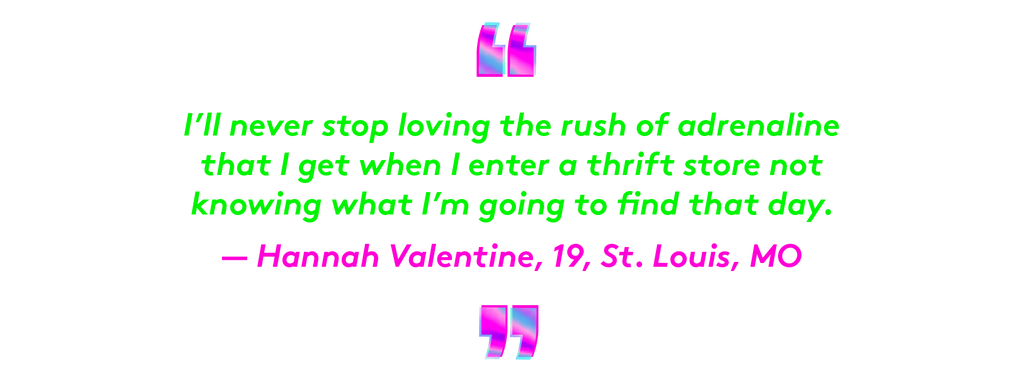
Hannah Valentine, a 19-year-old from St. Louis, Missouri, doesn’t even remember her first thrifting experience. “Thrifting has been a constant in my life for years,” she says. “I’ll never stop loving the rush of adrenaline that I get when I enter a thrift store not knowing what I’m going to find that day.” While Valentine fell for thrift shopping because of the search aspect, over time, it turned into something else entirely. “Now, I thrift because I want to help save clothing from being thrown away, while also providing an easy and accessible way for people to shop secondhand so that they’re not instead shopping on fast fashion websites,” Valentine says. The way she does the latter is through Depop, an online marketplace where many members of Gen Z have set up shop. (According to The Wall Street Journal, of Depop’s 15 million users in 2019, 90% were under the age of 26.) Valentine’s Depop page is scattered with floral maxi dresses, ‘90s sportswear à la Princess Diana, and retro pins from Steak & Shake. She offers sizes up to 3X and uses her platform on the app to advocate for people with disabilities. “I think of my job as a second-hand clothing rehoming service,” she says.
Another seller on Depop, 23-year-old Monique Miu Masuko, started her thrifting journey in middle school. Ever since her mom told her when she was a kid that buying secondhand was the easiest and most affordable way to stay on-trend, Masuko hasn’t stopped thrifting. Like so many others before her, took her favorite pastime and built a career out of it. Now her Depop shop has 2.8k followers. “[Thrifting] is more affordable, accessible, and eco-friendly — all three of which go hand in hand with sustaining Gen Z’s future,” she says.
According to Deloitte, Gen Z’s interest in thrifting could have something to do with having entered adolescence during the recession of 2007 to 2009, when the oldest members of Gen Z were between 12 and 14 years old. Many grew up experiencing financial hardship, and so it makes perfect sense that they’d be searching out economically friendly ways of staying in fashion.
Gen Z isn’t the only demographic actively shopping secondhand right now. Fashion search engine Lyst reported that, in September, there was a 104% increase in online fashion searches for secondhand-related keywords like “vintage fashion” and “slow fashion,” the latter of which was responsible for more than seven million social impressions. But they are the largest demographic: An estimated 46% of Gen Z shopped secondhand in 2019, according to Medium, compared to 37% of millennials and just 18% of Gen X. Since Gen Z has matured into its spending power, the resale market has grown significantly. In fact, it’s grown 21 times faster than traditional retail over the past three years to be worth $24 billion in 2019. It makes sense. Unlike millennials, who are said to “seek validation through purchases,” members of Gen Z are obsessed with being different from their peers. Ask the question of “why thrift?” for instance, and it will result in a wide variety of answers. (I’d know, I talked to over 30 of them.)
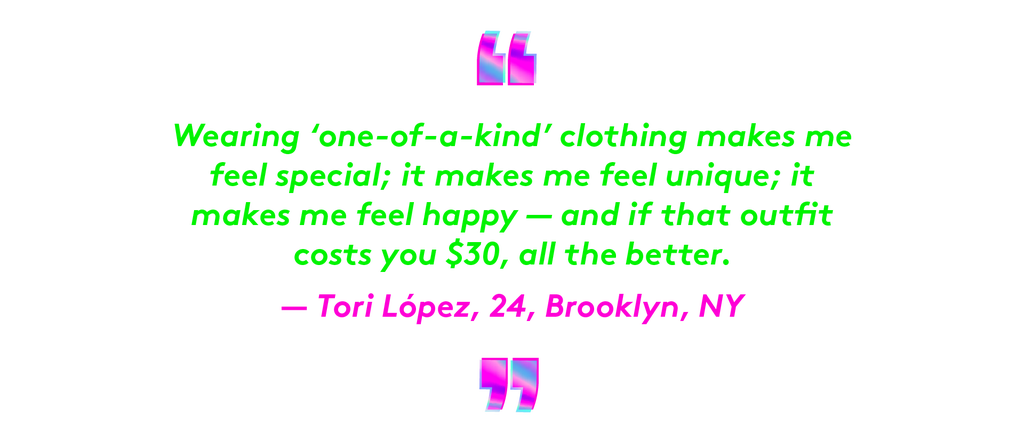
Some listed being able to look unique and build a more personalized sense of style as one of the reasons for thrifting. Tori López, 24, from Brooklyn, New York, says she found an “inexplicable sense of empowerment and independence” in wearing pieces that felt made for her, even if they were previously owned by someone else. “Wearing ‘one-of-a-kind’ clothing makes me feel special; it makes me feel unique; it makes me feel happy — and if that outfit costs you $30, all the better.”
Elena Dunn-Barcelona, a 24-year-old from Harlem, fell in love with thrifting during her senior year of high school because it allowed her to compete with her classmates style-wise “for an eighth of the price,” she says. “I was one of a handful of Black kids at a predominantly white boarding school,” she tells Refinery29. According to Dunn-Barcelona, everyone there wore the same things from the same brands (“Sperrys, J.Crew, Free People, Vineyard Vines, etc.”), none of which her parents were willing to buy for her: “There was no way they were going to hand me $60-plus for a top that would be out of style before the school year was over.” Thrifting made it possible for Dunn-Barcelona to build confidence in her style without overspending. It also allowed her to find options that fit when off-the-rack styles wouldn’t because of her scoliosis. “I have a shortened torso, and stand at only 4 feet and 4 inches, which makes shopping for clothing a constant struggle for me. But after a while, when I’d find cute things that didn’t fit me, I realized that someone else might love them, so I turned it into a business,” she says. Her Depop shop, Mighty Thrift, sells clothing in sizes 0 to 5X and has over 5k followers. By August 2021, she says thrifting will be her sole way of supporting herself.
There is also the matter of the climate crisis looming, which many listed as a major motivation for thrifting. “Thrifting taught me that I can positively impact this world in more ways than one,” Lopez says. “It’s granted me an entryway into a new way of living that feels more productive and purposeful.” She explains that what started as a mode of expression has since catalyzed a more intentional lifestyle, where, across categories, she’s more considerate about her purchases: “Now that I’m older, I find myself frequenting more local businesses, paying attention to companies’ stances on current political issues, and buying quality over quantity.”
During the lockdown, many young people took to TikTok for entertainment. In the process they also learned about the damaging effects that fashion — and other powerful industries — has on the environment. Of TikTok’s 800 million worldwide users, 60% are members of Gen Z, many of whom are using their fast-growing platforms to promote thrifting as an alternative to fast fashion and an easy way to minimize waste. The numbers don’t lie: #ThriftStore has 92.7 million views on the app, while #Secondhand has 90.8 million views. “So much of our clothes get worn a couple of times, then head to the landfill, which is really gross considering how many resources go into producing clothes,” says 24-year-old Lily Fulop, the author of Wear, Repair, Repurpose: A Maker’s Guide to Mending and Upcycling Clothes and a designer at Refinery29. “We need to produce less clothing, and make use of the clothes that are already in existence,” she says. One of the easiest and most affordable ways to do that is by thrifting: “It saves water, reduces microplastics and petroleum use, cuts down on pollution from pesticides, dye, and shipping… the list goes on.”
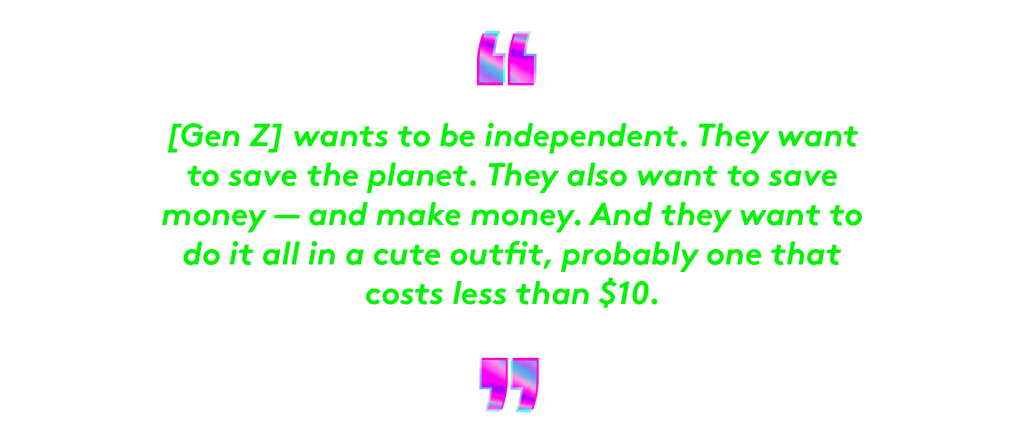
According to Emily Reyes, a 21-year-old living in New York City, Gen Z YouTube influencers like Emma Chamberlain are in large part responsible for showing young people that, unlike what their older family members or friends would have them believe, fast fashion isn’t the only way to find on-trend clothing at an affordable price. The 19-year-old YouTube celebrity — who has 9.6 million subscribers on YouTube and 8.3 million followers on TikTok — is known for frequenting Goodwill. Chamberlain’s thrift hauls, videos in which she goes through the items she recently thrifted and styles them on herself, are among her most popular videos on both platforms. Thrifting feels emblematic of the way that Gen Z prefers to stray from the beaten path — a path beaten to death by millennials, Gen X, and Baby Boomers, that doesn’t even seem to be going anywhere anymore. They want to be independent. They want to save the planet. They also want to save money — and make money. And they want to do it all in a cute outfit, probably one that costs less than $10. Thrifting makes all of that possible. Now that I know this, I look forward to making up for lost time.
It’s a cliché, but this year was supposed to be our year — full of independence, opportunity, or at least a few weekend afternoons spent with more than 10 friends with fewer than six feet between us. But with COVID-necessary social distancing, a shitty job market, and closed campuses, 2020 hasn’t given us much to work with. Past generations have had to deal with a recession, social upheaval, and changing norms: We’ve had to deal with all of it at once.
So, what now? What do we do with our careers, our relationships, and our lives? How do we move forward when we’re still stuck in our high school bedrooms? These stories are for us — filled with the resources, blueprints, and people who are finding ways to turn all this garbage into something like lemonade.
Like what you see? How about some more R29 goodness, right here?
अदा शर्मा को एयरपोर्ट पर स्पॉट किया गया, तो उनका सिंपल स्टाइल भी काफी इम्प्रेस कर गया। फिट फिगर की मालकिन इस अदाकारा पर शॉर्ट क्लोद्स काफी अच्छे लगते हैं और इस बार भी वे फेल नहीं हुए। हालांकि, जब ऐक्ट्रेस के चेहरे पर नजर गई और उनके मास्क को देखा, तो हंसी रोक पाना मुश्किल सा हो गया।